May 12, 2010

A Question of Life

This is part 3 of a 10 part series. The introduction can be found here, and the prior post can be found here.

Now, with a universe coming into existence that just happens to be fit for stars, planets, and complex chemistry, we have the question of how those biochemically complex systems (that we call life) came about. Even if an environment is perfectly suitable for habitation, it does not mean that it will automatically and necessarily produce the inhabitants. The arrival of such inhabitants is a separate marvel to be explained.

3. Abiogenesis
The problem of abiogenesis (the origin of the first lifeform) is one of the thorniest and most intractable issues in chemistry. Our increasing knowledge of microbiology and earth history has only added to the complexity of what needs to be explained. The simplest life is equivalent to modern bacteria, which is loaded with complex activity, information, and molecular "machines." The fossil record does not give evidence that there was a "prebiotic soup," or that there were any biological precursors to the first organisms, or that the atmosphere was the ideal mix to yield the necessary molecules, or that there was the expected long period of time between when the Earth could support life and when it actually appeared. Evolutionists regularly segregate the abiogenesis problem from the issue of evolution because (1) it is a challenge they'd rather not be saddled with, or (2) it is the most logical point for possible divine intervention. However, for the atheist there is no escaping this issue; they are obliged to seek out some purely natural explanation.
What hope for an explanation do you have? Are you satisfied to have problems like this that are unanswered, or even unanswerable?
In telling the tale of life on earth science writers often unconsciously use the word "miracle" for the appearance of the first organisms.
What kind of evidence is needed before we are to actually accept that something like this really is a miracle?

Randall starts us off by rejecting the idea that this is even a significant scientific challenge.

I don't know that [abiogenesis] is a thorny issue. Scientists see this as a fascinating issue; it's no thorn in anyone's side.

I think that any scientific issue that has been the victim of 150 years of unrequited investigation has the right to be called something like "thorny"; and if this issue does not qualify for such a label, then all of science must consist of simple and "fascinating" problems.

Faithlessgod thinks that I have overestimated the problem and that solutions are just around the corner.

Now is it the thorniest and most intractable problem, I don't think so. The fact that Pruett asks this is indicative that he really does not comprehend the nature of the work in this field. . . . it is not like we have no idea of the origins of life, indeed it is the opposite, we already have too many theories! . . . Of course we do not know which one is correct and all the current ones have some shortcomings . . . It most certainly is not at all intractable.

I do indeed comprehend the nature of the work in this field. It's not a naïve idea that everyone is just sitting around shrugging their shoulders that makes me call this an "intractable" problem; it's the knowledge of the issues relating to such work that leads me to use the term. The very fact that we have "too many theories" is a case in point. We only have competing theories because there is not a promising candidate bereft of difficulties. Faithlessgod admits that "all the current ones have some shortcomings," but a more accurate word than "shortcomings" would be "showstoppers."

I'll take the time here to review some of the technical roadblocks generally encountered by origin of life researchers. Later we’ll look at more specifics.

  • Life requires water, but the very presence of water prevents many of the chemical reactions required to build molecules necessary for life.
  • Certain conditions sufficient to form necessary molecules are just as likely to destroy them once created, like heat or UV rays.
  • The conditions sufficient to yield certain molecules are hostile to other necessary molecules. But those independent components of life must be able to coexist and survive before they can hope to form into units.
  • No matter how interesting a thing might be produced by chance, it is meaningless if it cannot reliably reproduce itself.
  • Even if a self-replicating molecule could manage to form by chance it is a quantum leap between that and the next theoretical level, which is something that can produce other molecules (like proteins) for its own functional entourage and also reproduce itself.
  • The simplest life that we know of or can even conceive of as a functional package is epitomized by interdependent systems that must come about as a group, with none of the parts serving any isolated function. There is a huge void between independent molecules (of any complexity) and life.
  • Any meager gains in theorizing how some part of a cell might come to form are continually outdistanced by the increase in knowledge of what it is that is to be explained.
  • Even where some mechanism might be theorized to form essential molecules, the statistical problem of fortuitous assembly of those molecules still remains, e.g., how you build a functional polypeptide chain (protein) from loose amino acids.
  • The time for chance to do its work is shrinking. By many estimates, life's appearance is now in the 3.8 to 3.5 billion year range, and this may only be because we have difficulty detecting it prior to these dates (note: Earth is alleged to be 4.5 billion years old, and would not have been suitable for life for hundreds of millions of years after that time).

Randall waxes nostalgic about some work from the 50's, which offered the first real experimental encouragement for origin of life researchers. She responds, "There are hundreds of theories of life's origins. The fact is, since the 50's, we've been improving on the Urey-Miller experiment." She then goes on to give a summary of the Urey-Miller experiment (extended by Carl Sagan), which produced some of the building blocks of life. She concludes by saying, "So we know it can happen."

First, I should point out that it is a long way between making a few building blocks of life to saying that you know that abiogenesis can happen! One might just as well claim that observing that stone can erode in block shapes means we know that the natural formation of Egyptian pyramids can happen by chance alone.

Second, let's go ahead and take a look at this experiment to get an idea of the specific kinds of problems associated with abiogenesis.

  • This experiment is dependent upon the assumption that early Earth's atmosphere was "reducing," and could thus form biologically significant molecules. That assumption is debatable (reference, reference, reference).
  • It was also important that the experimental environment be free of oxygen, which would be fatal to the formation of the desired molecules. Unfortunately, the date for the existence of free oxygen is being pushed back earlier and earlier in Earth's history, back to the time in which life was thought to have first appeared (reference, reference, reference).
  • The primary, significant molecular output of this experiment was amino acids, which are the building blocks of proteins. But only about half of the simpler amino acids used by life were produced.
  • All life is comprised of left-hand amino acids, but this experiment (and every other process known) produces both left and right-hand versions without discrimination. Peptide bonding has no preference for linking one form over the other, though advanced functionality depends upon them all being one handedness (known as homochirality).
  • Remember that this is a controlled experiment — intelligently designed, if you will. It contains a mechanism (a trap) to preserve the synthesized molecules from being destroyed once again by the two energy points and the water within the system. For this reason, the yield is certainly higher and more persistent than anything that might be found in nature.
  • Of the molecules that were produced and captured, the vast majority were biologically meaningless. The largest percentage was a tarry polymer, which would be evidenced in the geological record if amino acids in desirable quantities were produced by similar means on the early earth.
  • Given the limitations of the last few points, the overall yield of such an actual process in nature would have produced a very dilute prebiotic "soup." The thinner the broth, the less would be the chances for the right mix of molecules to find each other in order to combine. And remember, the combination of these molecules into meaningful systems is a matter of astronomical chance, which depend upon mass quantities to overcome statistical improbability. This is why oceans full of prebiotic molecules have long been the great hope and assumption of researchers in this field.

Francois doesn't deny that abiogenesis is a tough issue, only that it counts against materialism.

The fact that an issue is intractable does not indicate anything about that issue. It is only a statement about ourselves. We may not have enough evidence to get to the solution. There may even be limits on what human intelligence can comprehend, and a problem may remain intractable forever.

It's not what we don't know about chemistry that leads to the conclusion that this is a problem; it's what we do know. In fact, it was our past ignorance that led some to conclude that it wasn't a problem at all. Darwin's idea of life arising out of some warm little pond sounded plausible when it was thought that the cell was nothing more than a simple blob of protoplasm. And if you were to challenge scientists at that time for a solution they would be far more justified in saying, "Give us some time. We've only just begun to study the protoplasm to know what we're up against."

Today we understand much of the cell all the way down to the molecular makeup. In fact, we understand it and the problem so well that scientists no longer can fathom that the first organism would have been a complete cell; there supposedly must have been a series of proto-cellular entities leading up to even the simplest of the cells that we observe. (Francois affirms this modern adjustment to the theory when he says, "No abiogenesis hypothesis actually states that the simplest life is as complex as modern bacteria, and if it did, it wouldn’t be a very good hypothesis at all.") Never mind that the progression is totally speculative, it includes huge leaps, there is no evidence of such things, and that the existence of complete cells has been pushed so far back in history that the time for chance to build the cell by degree is vanishingly small.

For the committed materialist, this should be an answerable question in principle; chemistry is a fairly straightforward and empirical science. We should at least be able to show the chemical pathways to life even if we have difficulty in connecting those steps to actual geological history. If life indeed formed by natural means, then this has every hope of being experimentally repeatable. Unfortunately, decades of research have offered only a few token victories. I wonder how long we are to wait before applying any skepticism toward the materialist's story. 150 more years? 500 years?

Francois appears to think that we should wait forever; that it is unwarranted to ever plug God into any of our equations:

[This] is merely a modern iteration of the "god of the gaps" argument: "we can't figure out how abiogenesis actually happened, there is no hope to ever explain it, therefore God did it."

It is not as though science is annually filling gaps that Christians have tried to reserve for God. In fact, I'm struggling to think of any such gaps in recent history where God has been banished by science. On the contrary, modern science has revealed many "gaps" for which divine intervention is a neat and consistent fit. This issue of the origin of life and the need of a transcendent cause is a perennial one, which predates Christianity itself. The insistence that the cause is, nay, must be, a materialistic one is a historical newcomer (or at least was the minority report).

Darwin came along and offered us an alternate story. Why must we accept that story by default unless there is compelling reason to do so? Why should we accept "science" of the gaps in all matters? Richard Dawkins has famously said that "biology is the study of complicated things that give the appearance of having been designed for a purpose." If this is so, then it seems reasonable to assume that biology really is designed for a purpose unless and until it is demonstrated not to be. Materialism not only denies the burden of proof but any need at all to prove its own case. Crying "god of the gaps" is a stall tactic that has begun to ring hollow. In its echo I hear only, "we don't know." And “we don’t know” surely does not qualify as proof.

Here is another interesting problem for those who demand a material, unguided cause for life. There have been some who have honestly proposed that life might have come by way of directed panspermia. But how could we ever know if life were seeded by extraterrestrials if we are forced to rule out causal agents? Certainly, that would be a "natural" cause for life (since aliens are part of nature), but detecting the signs (or need) of such an intervention will be ruled out just the same by the prevailing methodology of naturalism.

One thing on which all my critics were united is the belief that I have mistaken what the fossil record is capable of revealing about early life.

Francois says:

The assertion that "the fossil record" does not contain evidence of the origins of life [is extremely problematic]. How in the hell could there be? Fossils form from hard structures like bones or the imprint of organisms in soft soil.

Anath says:

And why exactly would one think the FOSSIL record would say anything about atmospheric conditions or non-organic matter? Only organic matter is fossilized, which means there would be NO fossils until after complex life was formed.

And Faithlessgod says:

Really, how on earth does the fossil record tell us anything about the prebiotic soup? In saying this Pruett displays a deep ignorance of this topic.

To avoid this confusion, perhaps I should have used "geological" in place of "fossil" record. However, it is not at all uncommon to see the word "fossil" actually used in relation to phenomena surrounding life rather than just the remains of life itself. Terms like "molecular fossil," "geochemical fossil," and "fossil biomarkers" can often be found in the scientific literature. Some specific examples of early formations that are considered fossils, but are not themselves the direct remains of life are stromatolites and oncolites.

Beyond the quibble over my use of the word "fossil," the larger issue is whether or not we can detect much evidence for the state of the early earth and the earliest life forms by looking at the geological strata. Judging by the numerous studies and scientific papers, the answer to that question seems to be "yes." Some of the biochemical signatures of life or early life conditions would include banded iron formations, carbon isotope data, and other chemical biomarkers.

Additionally, it is not just bones and hard body structures of life that may be found in the fossil record, but even simple cellular life. Such "microfossils" have helped us to date the appearance of life (in forms that still exists today) to a time shortly after our planet was stable, but have not yet given evidence for the existence of any precursors to life. For instance, if an ocean rich in amino and nucleic acids had existed, which are necessary precursors of life, this would have left large deposits of nitrogen-rich minerals (nitrogenous cokes). Such finds are conspicuously absent from the early geological record.

Anath offers up a popular solution, and one that I, frankly, find to be the least absurd:

My current favorite theory is the RNA world theory but I understand that it is not without its difficulties. The reason I like it primarily has to do with the fact that I can visualize how it might occur and it seems like a logical explanation of how complex life could arise through simple enzymes and inorganic material. However, I also freely admit that my knowledge of biochemistry is pretty weak

That is part of the problem with this whole issue: it is easy to devise and believe just-so stories about how life came into existence. It is when these stories are examined in detail that we find the deep technical problems. Some may easily visualize how we could ultimately travel to the stars by going faster and faster with advanced spacecraft, or using worm holes, but any amateur astronomer or physicist can burst that bubble with a little dose of reality.

Here's a quick rundown of some of the issues with the RNA-first theory:

  • The same kinds of problems as with amino acids apply here, e.g., being able to create all necessary components, low yields, assumptions about earth conditions, homochirality issues (left/right-handedness).
  • RNA is chemically fragile (especially so at higher temperatures) and difficult to synthesize abiotically.
  • The fortuitous assembly of a catalyzing RNA chain is improbable enough, much more so one which could copy itself.
  • The known range of RNA's catalytic activities is rather narrow. Self-replicating capabilities are unknown, though a "cross-catalytic system involving two RNA enzymes" has been engineered. But that only compounds the probability issue, since chance would now have to provide two complementary RNA ribozymes at the same time and place.
  • Even assuming nature could produce the various necessary molecules in the same locale and in sufficient quantities for chance to do its work, it is no guarantee that other chemicals would not be present to interfere with the assembly of RNA chains.
  • If an RNA world actually thrived for the millions of years it would surely take to yield the DNA world, then it is odd that nothing of it remains. We certainly have every other flavor of lower organism still on display in modern times, e.g., when the eukaryotes came on the scene, the prokaryotes did not perish.
  • It is still a monstrous, inexplicable leap from RNA to the interdependent DNA-RNA-protein system (among other functions) of cellular life.

In a 2006 article in Commentary magazine, David Berlinski wrote a thorough essay outlining the problems and critiquing the proposed solutions. Organic chemist, Robert Shapiro (himself a supporter of evolutionary theory), says of Berlinski's essay, "the case against an 'RNA world' is even stronger than the one Mr. Berlinski presents. Not only were cytosine and ribose unlikely to have been present in any quantity on the early earth, but the same can also be said of adenine and guanine. Moreover, no adequate explanation of the manner in which these parts (and others) could connect together spontaneously to form RNA has ever been presented."

Long is not to be discouraged by such pesky details. He hangs his hope on a general confidence in the power of nature:

Scientists are constantly discovering new forms of spontaneous order, and I fully expect that trend to continue.

I recently read a sneering article which imagined that it refuted intelligent design by pointing out the "spontaneous order" that can naturally arise in the world of free market economics. I am not at all clear on how a system of conscious agents working in willful synergy serves as a good analog for mindless chemical reactions. On the other hand, there are indeed things in nature that naturally form into orderly chemical arrangements, like crystals, carbon fullerenes, and nanotubes. The problem is that order alone is not enough. Neither is complexity. Life is made up of molecules that contain specified complexity — they are in a specific, meaningful order.

A large crystal is very orderly; however, it is nothing but repeating patterns that form up according to natural, chemical laws — a reliable and reproducible process. On the other hand, the proteins, RNA, and DNA molecules in life are not comprised of repeating patterns. They are also not comprised of patterns that arise due to any natural affinities that one molecule might have for another. They are comprised of unique, specific arrangements of molecules that confer functionality to the system. In the case of DNA it is like hardware and software. Perhaps some natural process could be found that would make DNA strands — the hardware — but the arrangement of the nucleotides upon that strand is the software that drives life, and there are no chemical or electrical laws that cause nucleotides to naturally form into information-laden arrangements.

The arrangement of DNA is often compared to language, so let me end with this analogy. Even if we could find some way of spilling alphabet cereal that caused the letters to form into strings and columns (all right-side up), it still would not mean that they would make meaningful words and sentences. There is a quantum leap difference between discovering order in nature and discovering information.

Several of the responders objected to my use of the word "miracle" to characterize the reaction of scientists to this problem.

Self has this to say:

I cannot help that some writers use the word "miracle" to describe something. Some scientists may, indeed, believe that a miracle did occur; but others do not and may have just used sloppy language to state their case.

DB0 goes further to accuse me of outright dishonesty:

When a Scientist says "Miracle," he may actually mean something with a probability so low, that it's amazing that it even happened. Of course if one considers the sheer size of the universe, the possibility of anything like that not happening is what starts to get low.

However to take a word in general, claim that science writers use it, while not providing a context, and then use that as some kind of subconscious belief is nothing more than equivocation and very intellectually dishonest.

I mention the word "miracle" because it is a testimony to the fact that the scientific community does indeed recognize the scope of the problem and the shortcomings of the proposed theories. This word is seldom employed by science commentators; there is a reason it is used in this case.

Due to the intentional brevity of my original article I was necessarily constrained from offering quotes and detailed context for my questions. It is unfortunate that this should be received as "intellectual dishonesty." My context is that the word "miracle" has been used too many times to count in scientific exhibits and documentaries to which I have been exposed, as well as its direct use by the scientific community. Since my reply is anything but brief, I'll now reference just a few such cases where the word is used by academics in relation to life.

One of the miracles of life, to my mind, is the accuracy with which DNA gets itself replicated in the cell. It has to be that unbelievably accurate, otherwise we'd all die out in no time. (Alexander Graham Cairns-Smith)

As far as we've looked, there's only one place in the entire universe where the miracle of life exists: our own planet Earth. (Carl Sagan)

An honest man, armed with all the knowledge available to us now, could only state that in some sense, the origin life appears at the moment to be almost a miracle, so many are the conditions which would have had to have been satisfied to get it going. (Francis Crick)

The de novo appearance of oligonucleotides [i.e., specifically sequenced RNA bases] on the primitive Earth would have been a near miracle. (Orgel and Joyce)

Even I am willing to forgive these materialists for their "sloppy language," but the fact that there exist such vacuums into which the word "miracle" can readily slip tells us something about the nature of the problem. I can't remember the last time I've heard a mathematician, geologist, or chemical engineer employ the word. It seems that those who study life and its origins must be a particularly "sloppy" group, or there is something else going on here.

Is the appearance of life a "miracle" simply because it is a hard problem to solve, or because it is a matter of vanishingly small probability that it should have appeared? I would argue, and I think I have argued, that it is both. Nobel Laureate Christian de Duve has called for "a rejection of improbabilities so incommensurably high that they can only be called miracles, phenomena that fall outside the scope of scientific inquiry." The chance appearance of functional DNA, RNA, proteins and other elaborate large molecules qualify as such.

Some of my responders think it doesn't really make a difference if this is a problem for materialism that may never be solved. Francois offers this challenge:

If we accept the statement that the origins of life is a "miracle," the question remains unchanged: how did it happen? Even if Christianity was true, the Creationist would be no closer to an answer.

Self adds the following:

I'm very comfortable saying that any given problem can be unanswered. I'm not sure why xians feel that everything they can possibly imagine must be answered and if our current capability doesn't permit an answer then we must posit some sort of god intervention.

The point is not that all questions must be answered. There are some questions that by their very nature may not be answerable because there is a categorical disconnect between the cause and effect, like what caused the Big Bang. This is especially true when involving causal agents. For instance, we may never know the motive for the JFK shooting (why it was done), but we certainly can know how he was killed.

In principle, we should be able to say whether or not abiogenesis is possible. If such processes are part of the flow of the present material, observable world, then there is every reason to think that we could discover them. There is no practical veil between the cause and effect except our current ignorance.

If one is suggesting a natural mechanism or law, then one has something particular which could be exhaustively tested. But how do we know that something happened by natural means unless we can demonstrate that nature is capable of producing such a thing? The devil is entirely in the details in this case. Philosophical materialism seems to get a pass on this, unlike other theories that must offer evidences before warranting conclusions.

On the other hand, if life is the product of divine intervention, then there is a break of continuity with nature that we cannot push past with our theories and experiments. We cannot say precisely how God did it unless He tells us Himself, i.e., did He create from scratch, did He shepherd molecules together with secondary causes, etc. It is more a historical question than an experimental one. The best we can do, in principle, is to observe the evidence that life appeared without precursor and despite insurmountable improbability. We could find the various fingerprints on nature, at particular historical points, but not know the precise means of the handling.

It is not necessary to know the exact means by which an action is taken in order for it to be reasonable to believe that it did happen. If I find a fort standing where I left a pile of wood the night before, then I may not know how it was assembled or who did it, but I will surely be justified in my skepticism toward theories of natural causes.

Christianity is happy to live with open questions since it believes that God has reserved some mysteries to Himself. But some questions are relevant to the debate over His very existence. Materialists assure us that there is no evidence or need of a creator in the biological realm due to alleged natural processes for which they will someday find concrete support. Is it so unusual that theists should require evidence of such a thing before accepting its validity?

Regarding my observation that the issues of evolution and abiogenesis are so commonly segregated, Faithlessgod says this:

Some evolutionary biologists do separate origins from the evolution of life but simply because their specialty is the evolution of life, abiogenesis is not what they study. . . . Pruett seeks to manufacture a problem or an issue which does not really exist here.

Anath adds the following:

"Evolutionists" segregate abiogenesis because abiogenesis is a separate field of study. The Theory of Evolution deals only with the events AFTER abiogenesis, and cannot explain the origin.

Admittedly, it is two parts of a larger puzzle. In fact, it must be, because evolution only acts upon what is already alive and capable of reproducing. This makes it all the more difficult for origin of life researchers, since the gulf to be bridged is between simple chemistry and a complex self-replicating assembly rather than just "simple" mutations on existing DNA molecules. As Lynn Margulis has said, "To go from a bacterium to people is less of a step than to go from a mixture of amino acids to a bacterium."

However, I find it curious that the separation is so often and quickly pointed out in debates I have seen and had myself. It seems less for the sake of technical precision than for the sake of insulating evolution from collateral damage. At a metaphysical level, one may compartmentalize these two issues for distinct explanations. For instance, one could be driven purely by nature and the other require some transcendent involvement. However, the atheist does not have this luxury; He is saddled with a purely natural explanation for both. If one cannot be explained, then the entire atheistic project is failed.

To my question of what kind of evidence is needed to prove that the appearance of life is, in fact, miraculous, Anath replies:

A crocoduck. Something COMPLETELY impossible and unexplainable. Life rising from non-life is NOT a crocoduck. It is unusual and potentially quite improbable, but it is not unexplainable.

How can one dogmatically assert that abiogenesis is not unexplainable when it has for so long defied explanation and suffers all the practical roadblocks that I have presented here and more? This is merely the expression of a dogmatic faith in materialism.

Life from non-life cannot be like a crocoduck, in principle. As affirmed by you previously, evolution, which a crocoduck would supposedly confound, is a physically distinct issue from abiogenesis. Even if a crocoduck were discovered it would, at most, refute the theory of evolution. That is, unless you want to embrace the idea that they are indeed bound as one issue.

It seems to me that there is nothing analogous to this for abiogenesis that could be discovered, or that is not already known. The indisputable data we have is that it is simple chemistry on the one side and complete cellular life on the other. Discoveries of “crocoducks” in between the two might only serve to give confidence in the power of material causes, not refute it.

As it happens, neither the ongoing problems with each theory of essential molecule formation nor the increased understanding of the complexity of what is to be explained have served in any way to dampen the spirits of the committed materialists (with notable exceptions). What more could be discovered to disprove the materialists creation story? It is the incorrigible nature of the lack of supporting evidence for it that has any hope to stand as proof against it. But if “we’re looking into it” may eternally serve as justification for materialism, then any statistical improbability may be put into play.

As to the fate of evolution upon finding a "crocoduck," I am confident that belief in it would soldier on. The model would merely see a descriptive adjustment or make yet another place on its shelf for a future explanation. I have seen it happen many times before. The foundations may shudder and crack, but no one ever seems to question whether they have built their temple upon the wrong frame.

Some examples of “crocoducks”:

  • Biological classifications based on various markers (e.g., morphology and specific gene sequences) often do not align as expected. (reference, reference)
  • The meager accumulated evidence (since Darwin’s time) for the predicted gradualism as witnessed by 1) events like the Cambrian explosion, and 2) the discovery that the fossil record is most often characterized by patterns of stasis and punctuation.
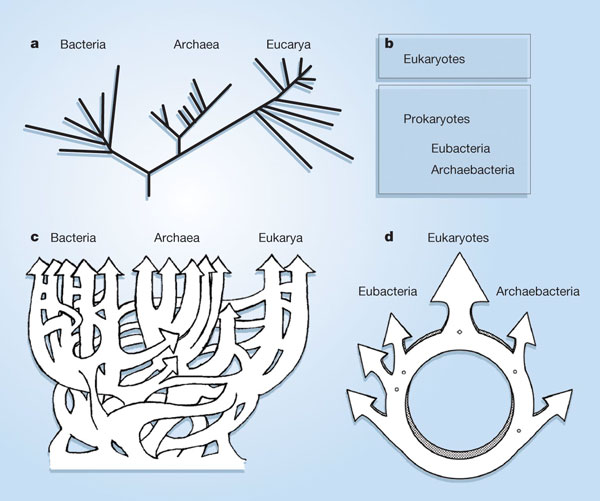
  • The discovery that the fundamental cellular domains of bacteria, archaea, and eukaryotes are found not to fit into the classical tree of life model (i.e., there is no clear line of descent either before them or between them). (reference, reference)
  • The discovery that the cell not only contains unfathomably complex molecules, but information-laden molecules.
  • The discovery that cells consist predominately of molecular machines, many of which are analogous to macro-scale human-designed machines. (reference, reference)
  • Even the genetic approximate of a "crocoduck" does nothing to phase the theory.

After effectively deflating the various theories of abiogenesis in his book, Origins: A Skeptic’s Guide to the Creation of Life in the Universe, Robert Shapiro makes the following interesting statement.

Some future day may yet arrive when all reasonable chemical experiments run to discover a probable origin of life have failed unequivocally. Further, new geological evidence may yet indicate a sudden appearance of life on the earth. Finally, we may have explored the universe and found no trace of life, or processes leading to life, elsewhere. Some scientists might choose to turn to religion for an answer. Others, however, myself included, would attempt to sort out the surviving less probable scientific explanations in the hope of selecting one that was still more likely than the remainder.

The materialist is free to continue seeking his alternative explanations, but it is unfair to demand that all explanations must always be "natural" even if they elude us for eternity. This is tantamount to saying that atheism wins, game over, and no further issues or anomalies will ever be considered as strikes against it. This seems a presumptive stance in a historically god-soaked world that, to use Dawkins' language, is full of "complicated things that give the appearance of having been designed for a purpose." Perhaps it appears that way because it actually turns out to be true. It is certainly consistent with the story that theism has been telling all along. Scientists may determine among themselves that all explanations must be by way of mindless, natural causes, but I am less interested in following the doctrines of "science," as defined by its secular high priests, than I am in discovering truth.

Labels: , ,

May 12, 2009

A Question of Order

This is part 2 of a 10 part series. The introduction can be found here, and the prior post can be found here. I will add two more blog responders at this point in the discussion. They are from:

The next question relates to the kind of universe that was produced by the creation event discussed in the first question.

2. Order

The past several decades have added profoundly to our knowledge of chemistry, physics, and cosmology. It has become increasingly clear that we live in a universe finely tuned for the support of complex life. This fact is so universally acknowledged that even secular scientists have coined the term "Anthropic Principle" to describe it.
How is it that we live in such an exquisitely fine-tuned universe? Even assuming that the universe could have popped out of nothingness, why should it have been such an orderly and hospitable one? Is there a scientific, testable answer for this question that does not simply appeal to imagination?

Faithlessgod offers this objection to the very idea of fine-tuning:

I disagree with Pruett's supposition here, it certainly does not look like an orderly and hospitable universe, since as far we can tell the range where the type of life we know could occur and survive is an incredibly minute portion of the universe.

Randall says it this way:

I don't think the universe is fine tuned for life at all. As far as we know there is only one planet in this one little solar system that can sustain complex life.... most of what's out there is space.

I wouldn't expect to have to go into great detail on this, since it has already been so heavily addressed by cosmologists. Those like Barrow & Tipler, Rees, Davies, Susskind, Bostrom, Smolin, and others have written volumes on this issue. The fine-tuning of the laws of physics (or Anthropic Coincidences) that permit the support of life in the universe is largely undisputed data. It is the conclusions drawn from that data where the true controversy lies.

Since there appears to be a misunderstanding of what I mean by finely tuned for the support of complex life I'll try to clarify the point. I do not simply mean that our own little planet happens to be hospitable to us, and I don't mean that the whole universe is a tropical paradise. I mean that the very laws of physics make things like galaxies, stars, and warm little planets possible at all.

Just two examples:

1) The electrostatic force repels protons (each being positively charged) while the strong nuclear force binds them together. The strong force is stronger than the electrostatic force, but only at short range, while the electrostatic force dominates at larger range. So, in order for nuclear fusion to occur, as it does in stars, there must be a certain amount of energy applied to propel one proton against another in order for it to overcome the electrostatic charge and stick via the strong force. I liken it to putting superglue on two plus-ended magnets and then forcing them together.

Since the universe originally consisted almost entirely of hydrogen, we would not have the abundance of heavier elements if it were not for the ability of stars to fuse atoms (and then spew them out in explosions). But if the strong force were too strong or the electrostatic force too weak, then fusion would be too efficient. Matter would more easily ignite and we would have fewer planets and more stars. Stars would burn out much faster and the lighter elements (being just as desirable as the heavier ones for molecule building) would be quickly depleted. Conversely, if the strong force were weaker or the electrostatic force stronger, then we would have fewer and larger stars, and less of the heavy elements. In fact, if fusion were too inefficient, then the large masses that might otherwise form stars could actually collapse into black holes before they would even have a chance to ignite.

2) The quantity, expansion rate, and distribution of the material of the primordial universe all have a part in determining the nature of its resulting cosmology. If there were not such a mysteriously large imbalance of matter over anti-matter, we would not have the material to form cosmological structures. Various factors seem to work together (e.g., inflation rate and dark energy) to determine the expansion of the universe. Minute differences in these factors would affect a number of things, including whether the universe recollapsed upon itself before anything interesting could be produced or whether it expanded too rapidly for the material to coalesce into structures like galaxies and stars.

It seems to me that a universe that survives its genesis, forms complex structures, and supports the generation and assembly of complex, diverse molecules is something we might even objectively value over a hiccup universe, or one that was filled with nothing but diffuse hydrogen gas. And even though there are more empty, hot, or cold places in the overall universe than there are just-right stars and just-right planets, it takes this kind of universe to be able to support such things.

If I were to accept the substance of Faithlessgod and Randall's complaint, I might just as well say that even our planet is not so great for humans because of all the hot, frigid, or wet places it contains. All these are either necessary for a life-sustaining climate/ecology (like an abundance of water) or they are simply byproducts of physics and geometry (like cold polar regions).

Tremblay takes issue with the idea that the Anthropic Principle has any relationship to the fine-tuning point that I raise:

LifeWay apparently does not know what the anthropic principle actually is. The anthropic principle does not support the fine-tuning argument at all. What the anthropic principle actually says is this: we live in a universe compatible with our own existence.

Yes, "LifeWay" understands the Anthropic Principle and its various permutations, such as the Weak Anthropic Principle (WAP), which will be discussed later. The very fact that there are even flavors of it is witness to my point that there is something of interest being discussed in the scientific community.

Of course the materialist would think the fine-tuning question does not support the role of a designer (else he would not be a materialist), but the Anthropic Principle is certainly born of the observation that the Anthropic Coincidences are necessary to the existence of observers. If the Anthropic Principle were nothing more than a tautological statement, like saying that coldwater fish are found in cold water, then I would not expect to find so many physicists and cosmologists writing books for the purpose of wrestling with its implications. Why try to explain away or rationalize an entirely meaningless observation?

A common rejoinder I've heard is that we shouldn't be so presumptuous as to think the universe is designed for us; it might have been some different way that would result in another species asking the same question. Self offers a form of this argument as follows:

To say the universe was fine-tuned just to permit life is backwards; what is more nearly true is that life is fine tuned to exist in the universe as it is today.

Anath makes the point this way:

It's like claiming your life is somehow miraculous and special because YOU were the specific result of your parent's copulation. Had a different sperm reached the egg first, or had something interrupted your parents before transfer that particular time, a totally different person would be saying the EXACT same thing.

It should be understood that I am not simply arguing for an egocentric view that the universe is fine tuned for humans or even for "life as we know it." If some member of a nebular squid species were to ask the same question, then I would grant his right to do so, because the Anthropic Coincidences would apply equally to him. I am arguing that the laws of physics are fine tuned for the support of life of any kind, which depends upon things like a universe, diverse materials, and the ability to form complex chemical structures.

Since there are so many other ways that the universe might have been that would not support life, stars, or even a persistent universe, and if there is anything noteworthy about complex, sentient, biochemical systems, then it seems that the least we can say is that this kind of universe is remarkably improbable.

At this point I have often heard the comment made: "Well, you wouldn't be here to wonder about it if it hadn't happened!" This is a hackneyed paraphrase of the Weak Anthropic Principle (WAP). To all my responders credit, I didn't see this voiced (in so many words). However, I think it is worth addressing, which I will do by simply paraphrasing the Swinburne/Leslie parable:

Suppose you are dragged before a firing squad. There are 100 trained marksmen all intent upon your demise. The command to fire is given. The guns blaze, but a moment later you discover that you are still alive, untouched by the bullets. You laugh out loud and marvel at your good fortune, but an annoyed captain of the guard simply growls at you, "There's nothing remarkable here, fool. You wouldn't be alive to remark about it if hadn't happened." And then he executes you himself with his own sword.

Even if the captain had killed you before you could ask the question, "How did I survive that?" it still would be legitimate for some observer to ask it. The WAP seeks to negate the observer's question by depending upon his existence. If he exists, he can't ask the question because he wouldn't be here to ask it otherwise. If he weren't here, then there's no one to ask questions so the problem is forfeit. It seems a hollow victory for the materialist to win on a technicality, but surely it is a more remarkable thing to have observers who ask questions than to have cold, dead space. I guess it is like a 3D stereogram. You either see it or you don't.

Faithlessgod goes on to raise a good point about other possible universes:

We have no idea what type of universes could occur with different constants, only that they would be radically different from ours, but this tells us nothing about whether the equivalent of life is more or less likely in those other universes.

The Anthropic Coincidences applicable to this universe suggest that of the kind of laws and materials that we are dealt, this particular arrangement adds up to something special. Perhaps some other dramatically different mix could add up to a recipe for success, but that would be another island in a vast sea of improbability as well.

To use a card analogy, which one of my responders employed, our universe's order may be compared to throwing a deck of cards up in the air and having them all come down in neat, numerically sequenced stacks by suit. There are certainly a large number of other ordered ways that the cards may come down, like numerically sequenced stacks of four-of-a-kinds, but they would be no less probable than the nearly infinite number of other chaotic arrangements that might result.

And to suggest that other radically different universes might help us here is to suggest that there might be a way that any old arrangement of its materials would yield order. This is like saying that in another universe made of dice instead of cards, that most rolls of the dice will come up all sixes, or in stacks. Perhaps there could be some universe where the laws are so rudimentary that there's no possible "variation," or any variation would yield the same assembly capability, but even that kind of universe surely would be less probable than all the other more dependent kinds, like the one we happen to occupy.

Interestingly, Tremblay makes an objection that would call this into question:

Implicit in this argument is the belief that the parameters of the universe could take any quantity. . . .

Just because we can imagine the gravitational constant being, not 6.674×10^-11 m^3 kg^-1 s^-2, but rather 6.252×10^-11 m^3 kg^-1 s^-2, does not mean that it can actually be 6.252×10^-11 m^3 kg^-1 s^-2. Just because we can write it down and make calculations based on it doesn’t mean it’s actually possible.

This is certainly a valid argument, but why think that the values could not be different? What meta-laws exist to constrain the amount of matter over anti-matter or the expansion dynamics entailed in the Big Bang? Even if the laws and events inherent in this universe where somehow necessary or predetermined, then this only pushes the question back a level. Why should the "necessary" laws be so remarkably configured? Why would the brute laws of physics have to favor order? How very fortuitous!

A popular theory among cosmologists involves the idea that we exist in just one of a number of bubble universes. While I will not attempt to psychoanalyze the motivation for such a theory, I will note that I have usually seen the theory employed as a response to the Anthropic Coincidences. As the argument goes, we just happen to live in a jackpot universe that is just right for life. Unlike Tremblay, these cosmologists don't seem to have a problem with the idea that the universe-barfing device may have different settings. Nor do they seem to agree with those who argue that there just isn't anything special to be explained or they would not make appeal to infinite universes for that explanation.

Tremblay closes with this conversation stopper:

As for the question "why should [the universe] have been such an orderly and hospitable one?", it should be obvious that the use of "why" presupposes teleology, and therefore a Creator. So this question is entirely circular. There is no purpose for the universe to be the way it is, any more than there is a purpose for the sky to be blue instead of green. We can explain how it came to be hospitable, or how the sky gets to be blue, but there is no "why."

Perhaps we should break the news to those like cosmologists Bernard Carr and Martin Rees, who once stated in the journal Nature, "Nature does exhibit remarkable coincidences and these do warrant some explanation." Perhaps we should simply think of them as philosophically naïve to require explanations, but it seems to me that science is all about the "whys."

Tremblay suggests that explanations should extend only to the reason for the physical condition (like, the sky is blue because of short wavelength light diffusion), but not to any deeper meanings (like, why should physics have to work in such a way that it yields lovely blue skies?). Perhaps this is a good rule of thumb for science proper, but it is a castration of the human spirit, which, for some strange reason always wants to go the extra mile in its understanding.

Materialists would apparently say to us, "Just get over it! There's no meaning to this or any other aspect of existence. Everything just is what it is." For my point in question, this means that even if it actually is the case that the universe is fine tuned for complex life (of any kind), and it is a genuine statistical improbability, then we are disqualified from having stray thoughts of wonder because they presume something to wonder about that does not exist: teleology (purpose/design/meaning).

It is true that this, and many of my questions, depend upon teleology. In fact, teleology is part-and-parcel to the worldview I am advocating. But surely teleology cannot be ruled out a priori any more than we could meaninglessness. I might just as well claim, "the atheist can't say the universe just is what it is, because that's a circular argument: it presupposes that there actually is no meaning to the universe." How, then, is one to demonstrate the need of a designer if one cannot point to anything as evidence merely and precisely because it supports his thesis!

Labels: ,

April 27, 2009

A Question of Cosmic Origins

This is part 1 of a 10 part series. The introduction can be found here.

The first topic relates to the great historical question of origins and trades on concepts found in the Cosmological Argument for the existence of God.

1. Creation

The overwhelming consensus of science is that the entire cosmos (including space and time) came into existence at a finite point in the past. All of our observations, equations, and physical laws testify to a point of origin for this universe.

In light of the troubling evidence for a beginning, and that we may not even be able to find a natural cause in principle, what explanation is given to the questions, "Why is there something rather than nothing?" and "Where did it all come from?"

Francois Tremblay proceeds to take issue primarily with the logical composition of my question.

Asking "why is there something rather than nothing" is a fallacious question since "is" implies existence and "nothing" implies non-existence. It's a question that Christians like to ask because it's by definition unanswerable, not because atheists have no ready answer but because the question itself is contradictory.

Roderick T. Long further elaborates the objection.

It makes no sense to ask for an explanation of the whole of existence – whether that whole includes a God or not. Any attempt to explain existence has to appeal either to something in existence or something not in existence. If it appeals to something that’s already in existence (be it God, quarks, or whatever you like), then you’re not explaining all of existence; and if it appeals to something not in existence, then you’ve offered no explanation at all.

My point was not to ask a trick question, but to seek a reaction to the fact that this universe gives evidence of a beginning. When I speak of something and nothing I am speaking from the materialist's perspective. Of course, as a theist, I believe that "something" has always existed; I have a "first cause" or "prime mover."

Long basically understands this, as he continues:

The concept of explanation applies only within the realm of existence; that’s why both theists and atheists agree that chains of explanation stop with something whose existence has (and needs) no explanation beyond itself – whether it’s God or energy.

This is a good observation, and actually is the kernel of the response I would make to George Self when he asks, "If a xian wants to take the beginnings back to some god that made it all, I would ask, 'but who made god?'" Something has to eternally exist or there would be nothing right now. Something cannot come from nothing. We suggest that this something is God, whose very definition includes the idea of self-existence and eternality. If the atheist will not allow an eternal God to stand as an acceptable first cause, even in theory, then the atheist has no grounds to lean upon an eternal universe (or energy) either.

The problem that I point out with this question is that even if it might be conceptually possible to have an eternal universe (which I could argue against as well), by all indications this one had a beginning. I am not asking for an explanation for the universe, which might lead to the counter-question of why there is a God; I am asking the atheist what he (or she) does with the evidence for an origin to the universe.

Alison Randall takes (in my mind) the sensible position that "nothing does not and has never existed . . . because you can't have anything come into existence from nothing."{1} This serves to underscore the problem of our current observation that all space, time, matter, and energy burst onto the scene at a finite point in history. If it can ever be said to have come from "nothing," or no prior state can be identified, then materialism will have hit a dead end in one of its most important avenues of justification.

Randall then goes on to postulate that "everything always existed . . . as a dense singularity of energy-matter." Here's where we could get into an arcane scientific discussion and I could ask things like, how "infinitely small" (as the singularity is often described) is distinguishable from "nothing," how something natural could exist prior to the space-time continuum in which existence is defined, and why a gravity well isn't happy eternally staying that way.

But I don't need to go here, because there is not even agreement on the idea of the origin of the singularity. For instance, inflationary theory, which is the prevailing big bang model, says that the singularity was generated by something like a "quantum fluctuation." Membrane theory doesn't even have a place for a singularity, and one of its advantages is the very fact that it doesn't have to wrestle with the difficulties associated with one. As this physics article explains about one of the big bang models that require a singularity,

The problem with the Big Crunch/Big Bang model is that the mathematical laws of classical general relativity do not work at a singularity. And if scientists cannot mathematically understand the singularity, they cannot, in theory, fully understand the geometry of spacetime, either before the Big Crunch or after the Big Bang.

Randall continues her response:

I don't pretend to know a lot about it, but [the Singularity/Big Bang model] seems to be one of the best explanations we have right now, along with other ideas . . . like string theory, multiverses, and such.

Umm, which theory was it that is the "best explanation?" She lists these other things because there is NOT an explanation right now, only theories, else we wouldn't have other contenders vying for dominance. I think Randall knows this, but she adds this parting shot to show where her preferences lie:

The theories that are made from observable evidence are a lot more juicy and intriguing than ancient mythologies.

Unfortunately, the only observations and evidences we have say nothing more than that there was a beginning to this universe. There are not so much theories made from observable evidence as there are only theories seeking evidences as to how that happened by "natural" means. This is exactly why there is so much excitement over things like the Large Hadron Collider and Planck satellite, which are hoped to offer supporting evidence for one or another idea (though how we can prove the nature and events of something "outside" this universe using observations born of the laws contained within it I do not know).{2}

The bottom line is that there's really not an explanation for the origin of the universe, and naturalistic explanations are simply occasions to engage in sci-fi narratives. As Leon Lederman (Nobel Prize winner in physics) says in his book, The God Particle:

A story logically begins at the beginning. But this story is about the universe and unfortunately there are no data for the very beginning. None, zero! We don't know anything about the universe until it reaches the mature age of a billionth of a trillionth of a second — that is, some very short time after the creation in the Big Bang. When you read or hear anything about the birth of the universe, someone is making it up. We are in the realm of philosophy.

This is where the discussion must ultimately end. As George Self concludes, "I'm quite comfortable saying, 'I don't know, and neither does anyone else.'" And one blog commenter summed up the responses by saying, "I don't know, but science is looking into it."

Fine. That is an honest and somewhat acceptable answer. Every worldview must be permitted some mysteries. But if this is a satisfactory response for all the intractable problems of materialism, then atheists shall forever be free to think themselves rational, since science will always be "looking into it." However, I doubt they would be so kind as to allow us to reply to their tough questions with, "I don't know, but our theologians are looking into it."

Without overstating my case, it seems reasonable to say that evidence for a beginning to this universe is at least problematic for materialistic atheism. And even while atheists can avoid a proof for God by eternally leaving the question open to scientific investigation, we should be able to say that a cosmic origin is at least consistent with theism, particularly classical Christian theism.{3}

After offering his shrug to the problem of cosmic origins, Self adds this addendum:

Even if I wanted to assume that time had a beginning at some point in the distant past that still does not prove that the xian "god" created that point. Perhaps the cosmos was started by a unicorn or a magic genie.

Unfortunately, this does not at all avoid the problem for the atheist. A magic genie or unicorn with the power and knowledge to create our universe would still be a god, for all practical purposes. What Self does do is touch on the fact that the Cosmological Argument is limited in the work that it can accomplish. Even if the atheist were to concede the need of a creator, it is another thing to demonstrate the nature of that creator. For this reason, the Cosmological Argument can never be more than an argument for theism in general{4}, and must work in conjunction with other arguments to arrive at the God of Christian theism.

~~~~~~~~~~~~

Notes:

  1. There are some who disagree with Alison and are bold enough to accept the premise that there once indeed was nothing. Dr. Peter W. Atkins (himself an atheist) holds that the "nothing" managed to split itself into the positively and negatively charged universe that we enjoy today. Tada! The Force stays in balance, since "nothing" has yielded a universe with a net charge of nothing, and may return to such in the future. It's all virtual nothingness with no gross explanation required. It all sounds rather artful as a high level theory, but explaining exactly how "nothing" managed to send itself on an extended holiday is where it begins to unravel.
  2. I might conversely say to Randall, "Theories with a long philosophical pedigree are a lot more juicy and intriguing than ideas from sci-fi movies."
  3. You can expect this to emerge as a recurring theme in each of my questions.
  4. In fact, cosmological arguments have been in play since long before Christianity was founded.
Part 2 can be found here.

Labels: ,

10 Replies to the Atheists

A while back I wrote the article, 10 Questions for the Atheist. It has elicited a number of responses since that time, particularly on some recent blogs. I thought it might be time to do a follow-up series to deal with replies to each "question" in my article. I'll proceed by taking each question in turn — one per post — and addressing some of the responses I've encountered.

I began the article with this statement:

Atheism, by definition, holds that there is no God and nothing beyond this world of matter, space, time, and energy. Consistent with this viewpoint come a large number of necessary truths and the problems relating to them. Atheism is not made rational merely by the rejection of the evidences for God; it has its own wares to sell and difficulties to overcome. Here is a sampling of the kinds of issues which atheism is obliged to address.

By this, I mean to point out that atheism is more than just a rejection of the God proposition. It is its own proposition. It makes its own worldview claim and is saddled with certain questions and mysteries that still emerge and must be answered in a way consistent with atheism. Theists are often charged with having a too-easy answer for life's mysteries: Goddunnit. Questions of origins, design, morality, and consciousness may be "conveniently" dispatched by appeal to the Deity, but they are left on the table for the atheist to address. And if the atheist has no solid answer to life's most compelling and fundamental questions, then exactly what is it that justifies atheism as a rational contender? Why believe atheism to be true apart from compelling answers to such questions? Why not be agnostic at most?

One atheist responds to my opening statement as follows:

We already have another word for that, it’s called "materialist." Atheists are not beholden to hold to any positive claim about whether there is something "beyond this world" (whatever that means exactly). There are atheists who believe in supernatural things like souls, ghosts, weird energies, and so on. So we have to assume that [the] whole set of questions here is not actually about atheists at all, but rather about materialists. (Francois Tremblay)

I will have to agree that "materialist" is probably a better word for what I describe here, and that this represents a subset of the "atheist" population. However, it is the largest subset, the most vocal, and in my mind it is what most reasonably follows from the concept of atheism. I am not, here, concerned with atheists who make room for spiritual elements, and apparently Tremblay does indeed know what I mean by "beyond this world," since he continues on to list several fine examples of otherworldly things, like souls and ghosts. It seems to me that if one is comfortable with the idea of immaterial beings, then there isn't any principled difficulty with the idea that one Being might be greater than us and precede even the material world that we inhabit.

Next I'll move on to my "questions." Each one is presented with a bit of contextual setup, followed by one or more actual questions to the atheist that relate to the topic. The setup is unfortunately brief, of necessity, but is itself food for discussion.

The responses I'll be addressing come from the following persons:

This is the introduction to a 10 part series. Part one can be found here.

Labels:

October 08, 2008

Ghost in the Machine

Sobbing, shaking and knowing death was imminent, [Nancy Reagan] held her husband's hand about 1 p.m. Saturday as he inhaled deeply and opened his eyes for the first time in five days.

While most thought Alzheimer's disease had robbed former President Reagan of all his memory, the last look he gave his wife was one of deep acknowledgment, [his daughter Patty Davis] writes for People magazine.

"At the last moment when his breathing told us this was it, he opened his eyes and looked straight at my mother. Eyes that had not opened for days did, and they weren't chalky or vague," Davis recalls. "They were clear and blue and full of life. If a death can be lovely, his was."

Davis and her brother Ron were standing next to their father's bed when the astonishing interchange between their parents took place.

(Source. Other sources.)

After Ronald Reagan's death I watched a television interview where Ron Jr. recounted this story himself. He was very emotional as he spoke, and it was clear that he believed that something profound had transpired. His father had apparently burst forth through a broken body to bid farewell to his beloved wife. This kind of story is not unique in my experience, but what makes it interesting is whom it is that is telling it here and how it fits into his overall view of human nature.

Ron Reagan Jr. is a self-described atheist. Consistent with, and common to, atheism is the philosophy of materialism. Materialism is the idea that all things that exist can be explained in purely material terms, and there are no entities such as gods, angels, or human souls which exist beyond the boundaries of the physical universe. This means that the "mind" is simply an emergent property of the physical brain — without a brain, there is no mind. It also implies that a malfunctioning brain will yield a malfunctioning mind. Given a materialistic outlook, how does an atheist like Ron Reagan process his father's last moments of life?

Alzheimer's is a degenerative disease, which affects the brain cells and the connections between them. A brain at the fatal end of this illness is a devastated organ from which an identifiable "mind" should not hope to emerge. In the case of Ronald Reagan, he had not even opened his eyes in days, and had not been alert for years before this. From where, then, does a clear-eyed Reagan suddenly surface?

At the very moment when his body was so far gone as to yield to death, Ronald Reagan became animated — himself again. If a body is broken, why does it not naturally and successively proceed from almost dead to actually dead? If we flatten the tires on a car, drain its oil, and pull half it spark plugs, do we expect it to have one last burst of blazing performance before it finally sputters and dies?

Perhaps it is like the runner, who after exhausting all resources at the end of the race finds in himself one final burst of speed for the finish line. But this is not an accurate analogy, because the racer does indeed have something left to give. He is simply very low on carbohydrates and is inhibited by the pain of lactic acid buildup in his muscles, which makes him pace himself to the end. In that last burst, he is drawing on the remainder of his resources but could not hope to continue long in this. To be an accurate analogy, we would first have to sever some tendons and break some bones. No matter how brave or determined one is he cannot get far or fast on broken legs.

The other problem with this analogy is that a runner can will to briefly overcome his fatigue. But here we are speaking about the very thing from which something like a will is supposed to originate: the brain. In the materialist paradigm there could be no Ronald "in there" to triumph over his failing brain — a brain so destroyed that it could no longer even support life itself.

So what happened that night: one final power surge resulting in the shutdown of a fragile system, or a man rising from his broken body to say farewell before passing on? Ron Reagan Jr's heart is urging the latter. But how can he maintain this as an atheist? As most atheists I'm sure that he thinks of himself as an eminently rational creature. But to be consistent, I think he must either give up his materialism or give up his sentimental notion that something extraordinary happened that Saturday afternoon.

Labels: , ,

September 06, 2007

Santa Claus Morality

"I think [heaven is] a bad concept to have because then everything you do, you want to do good things in order to get to Heaven. Then everything becomes a selfish act, and I hate that, it creates bad patterns in your mind. I like doing things not as a means to get into Heaven but for the sake of doing it themselves."
Natalie Portman, Actress, Inside the Actors Studio, Episode #11.7 (2004).

"The threat of damnation is designed to be an incentive to right action; but this is a phony morality. Humanists think we should do good for goodness' sake, not for the selfish prospect of reaping individual rewards or avoiding punishment."
Dan Barker, Atheist and Former Pastor, "For Goodness Sake", Freedom From Religion Foundation.

"I believe in goodness for goodness' sake, not because you're getting some reward in the afterlife. If you're being good for an award, then what sort of person are you anyway?"
Bill Maher, Political Satirist, "I'm spreading the anti-gospel", Chicago Sun Times (10/24/04).

~~~~~~

This common objection is meant to be a defeater for the concept of Christian morality, but it really does nothing so much as to demonstrate a deep intuitive knowledge about morality. Claiming that we ought to "be good for goodness' sake" assumes four very important things about the nature of morality.

Morality is Objectively Real

The first thing this claim demonstrates is the belief that good, and by extension, evil, are real things. Indeed, "good" is being held up as some ideal, perhaps even independent of God, which we should strive to pursue for its own pure ontological beauty. For this reason, a moral relativist is not well served by this objection. In his mind, morality is simply behavioral preferences and cultural conventions. Morality is not something "out there," apart from humanity and applicable to all times and places. There is, then, nothing other for the sake of which we might attempt to be good.

If there is no objectively real morality, then we can only be good for our own sakes, that is, for the sake of our own feelings about morality. We might be good for the personal benefits that are achieved by acting in certain ways, but we cannot be good for the sake of an abstract, transient concept. It is not something that we separate from ourselves and put upon a pedestal as though it had an existence apart from us, its maker. You might just as well say we should eat ice cream for the sake of The Favorite Flavor. No, we eat it for the sake of our enjoyment, whatever our favorite happens to be, assuming we even have one.

Even if "good" turns out to be a changing and subjective thing, then the very idea that we should take pains to follow it is itself an objective principle, which would in turn foil moral relativism. If morality is not a real thing with some purpose and value behind it, then what right or meaning is there in a relativist telling us we should bow to the idol of morality? And exactly whose idol should we bow to anyway?

Moral relativism makes it difficult to meaningfully speak in moral terms, but it is the legacy of those who do not allow a God that meddles in human affairs. Consequently, atheists, who employ this objection most often, are admitting far too much in even voicing it, since it requires morality to be tangible and particular to even make sense.

Morality is Personal

The second thing that this claim implies is an understanding that morality has a personal basis. We don't do things "for the sake of" inanimate objects. We do things for the sake of personal beings who we seek to honor, impress, love, protect, appease, etc. It makes sense to say that I should care about hygiene for the sake of my spouse and stay married for the sake of the kids, but it does not make sense to say that I should shower for the sake of the soap and stay married for the sake of the appliances.

To say that we should be good for the sake of goodness is to ascribe a personal nature to morality. But this cannot be done if morality is merely a human, subjective phenomenon. Yet even atheists have a deep sense that we ought to do certain things and that other things simply should not be done. But "should" and "ought" are the language of moral incumbency, which is born of law. And law implies a law giver.

The question is whether we humans are making up these laws ourselves as we go along, or whether the laws have been written for us by someone higher. If by ourselves, then we can only be good for the sake of our own self-interest. But if morality has another author, then we should be good for the sake of that One, not the inanimate thing derived from that One.

The Highest Morality is Selfless

The third thing that this claim demonstrates is the belief that self-serving morality is a parody of true virtue. To say that we should be good for the sake of goodness suggests that we should behave in a way that looks beyond the resulting personal benefits. You aren't thinking about morality in the traditional sense if doing the right thing requires you to first ask, "What's in it for me?"

But if morality is simply a creation of society, then it will surely reflect (at best) the shared self-interests of the individuals which compose that society. And if we are just creatures of nature, then evolution (our supposed creator) is the ultimate master of our moral urges. The problem with this is that evolution is selfish by definition. Its primary focus is the survival and competitive advantage of individual gene carriers. Advantages to broader communities are of concern only insofar as they benefit individual reproducers.

There is really nothing practical about the idea that we should expend our precious resources to care for, and allow reproductive rights to, the unproductive and genetically inferior members of society. The theory of evolution certainly doesn't give cause for such thinking. And there is no sense in the idea that a fit and fertile person should lay down his or her life to save the life of someone else who is weak and impaired. Yet one of the most egregious moral crimes in society is to abuse or neglect the helpless, and one of the noblest acts is to dedicate one's life to their aid. This is self-defeating sentimentalism in a purely material world, but makes perfect sense if there is something higher than self and the survival of the fittest.

Good Works do Not Earn God's Favor

The fourth thing that this claim reveals is the intuitive knowledge that works-based righteousness is a spiritually bankrupt idea. If the Christian God indeed exists, then it would be petty for us to only seek to do good in order to win His favor. The objector is right to see such self-interest as tarnish on all our good works, and just how good would we need to be for a God to whom we owe everything in the first place? Seventy-five percent good? Fifty percent good? Whatever the line, it would mean that both heaven and hell are home to many borderline cases. 'Tis an awfully wide gulf that could separate two souls by one four-letter word.

The irony is that Christianity does not even teach that we win heaven by virtue of our good works. In fact, it may be the only religion that explicitly rejects such an idea. For example, Islam actually teaches that our good deeds must outweigh our bad, and Eastern religions teach that we must work our way to enlightenment through various moral and spiritual practices. By contrast, Christianity teaches that we must put aside our futile thoughts of measuring up to God's perfect standard and throw ourselves upon the mercy of His court. We have but to accept, as spiritual beggars, the provision He has made to cover our sin and win our righteousness in Christ.

Good works come as a result of our love and gratitude toward our creator and redeemer; they are not the cause of our redemption. The Christian ideal is to be good for God's sake, not for the sake of what He can do for us. God is not to be confused with Santa Claus. To think otherwise is to make the mistake that Satan made regarding Job's motivation for righteous living (Job 1:9-11).

Conclusion

The claim that we should "be good for goodness' sake" is problematic at face value for the non-religious and does not even manage to apply to the Christian understanding of God and morality. It assumes a rather more substantial view of morality than atheism has a right to claim; it assumes a higher form of virtue than what evolution would be concerned to impose; and it assumes something about how God ought to view moral effort that Christians have been teaching all along.

Matthew 12:36 says that every idle word will be brought to account in the final judgment. The use of this complaint will surely come back to haunt those who have applied it against Christianity and have not availed themselves of God's mercy, do not think of themselves as being so bad as to deserve hell, and even go so far as to doubt the existence of an Author of morality. The objections of the skeptic often say far too much and contain the seeds of his own destruction.

Labels: , , ,

August 06, 2007

Keep Your Mitts Off My Meaning

Though it is often disputed by atheists, it seems to most Christians a self-evident truth that if there is no God there is no meaning to life. There can only be a purpose if there is a planner — someone to establish that purpose and equip us and the creation to that end. Of course, you could always appeal to evolution as our maker, but then you are stuck with only a meaning that chance has wrought: to survive and breed. This is deficient both in its banality and in the nature of its ultimate origin. It is not the kind of answer people have in mind when they ask, "What is the meaning of life?" And if they ask the further question of what meaning there is to reproduction and survival they quickly fall into the pit of nihilism.

The thoughtful atheist's reply, having the all too common allergy to nihilism, is to admit the lack of meaning in any objective sense but to point out our resulting freedom to define life's "meaning" for ourselves. How very glorious! We get to dream up our own answer to the most foundational question of existence. Best of all, since there is no right answer, there is also no wrong answer. Who is to say to another, "No, you have picked the wrong meaning; you must choose some other"? There is no supposed objective standard in play to constrain one in crafting a personal meaning — no principle to demand that it must be according to, say, scientific truth. If there were, then that in itself would suggest some form of objective meaning to our existence.

Even though the atheist's meaning of choice is often some form of secular humanism and scientific triumphalism, it is not to say that this is the correct meaning for all mankind. It may seem preferable to live boldly according to the truth that there is no God and to soldier on for the glory and survival of the human race, but that attitude is not ultimately better than those who think that humanity is a blight on nature and we should permit ourselves to go extinct. We may not like some people's invented meaning, but it is theirs to make nonetheless. That is, if atheism is true.

The problem is that many atheists do not have a live and let live attitude about metaphysical beliefs (though I admit that some do). They feel that religious adherents are wrong, foolish, delusional, or even downright wicked in some cases. Of late, some rather high-profile atheists have even been so bold as to suggest that a war must be waged against religion. It is not enough for atheists to (understandably) seek to partition themselves from religion so that they can be free to follow their own values; they want to disabuse religionists of their wrongheaded metaphysical ideas. They want them to live according to the atheist's own idea of "truth" and how we ought to respond in the face of it. They want to preach it in the schools and from every media pulpit that they can command.

Ironically, it is the atheist's version of truth that entails, at the outset, that there is no truth regarding meaning and moral principles. It is the prerogative of humanity to identify value and meaning for itself, and there are many who are busily doing just that who do not happen to be atheists. At least the theist believes, rightly or wrongly, that his truth is a real Truth that matters for all parties. He may be deluded and bothersome, but he is at least logically consistent in his attempts to proselytize others.

The atheist is like the bully who tells his little sister, enjoying her tea party, that her bear and doll guests are just dumb, stuffed creatures and that she's a silly girl living in a fantasy world. If she does not run off sobbing to her bed she might at least abandon her game, the spell broken and the fun evaporated. You see, it is in the illusion that the fun is to be found. Likewise, it is in the belief that Christianity is actually true that the comfort and meaning lies.

The typical atheist means to purge the Christian of his religion if possible or at least the propositional truth of it. All this in the name of the "truth" as he sees it, cold and hard as it may be. He may just as well tell our little tea party princess that she is a chance byproduct of a meaningless natural process; the only reason her parents appear to love and care for her is because of biochemical mechanisms meant to insure the survival of their own DNA; and when she dies she will return to the nothingness from which she came and no one will remember her in 200 years or so. When she runs off sobbing to her bed he can feel justly satisfied that the truth has been served and that he's made a contribution toward insuring that she does not grow up to continue having juice and crackers with dolls or in memory of imaginary crucified deities.

The evangelizing atheist is a metaphysical bully who presses his own truth upon the religious for his personal amusement and self-interest. He is certainly not doing them any favors, since I am not sure that any atheist has ever gone to the grave with a smile and many have gone by their own hands. The sad dilemma for the atheist is that if he is right, then there is no right, from morality to meaning. He can lobby and vote and whine all he likes for his cause, but the last thing he can do is sell it as the truth to which all the world should submit. In doing so he only compounds his sin of actually being wrong about the existence of God. But that is another discussion.

Labels: ,

July 27, 2007

Moral Atheists - Good by what measure?

In all my interactions with atheists I have noticed a curious thing: they are very keen to be thought of as "good" people and insist that it does not require a deity in order to seek to act morally. Indeed, they claim that it is nobler to be good for its own sake than to be good for the sake of rewards gained or punishments avoided, which they believe theism entails. There are several problems inherent in this idea, but what I want to explore here is the problem of defining the "good" and considering whether we find atheists, in fact, acting according to such a definition.

(Note: for the purposes of this essay when I use the term "atheist" I mean anyone who builds his or her ethics apart from the idea that moral imperatives find their source outside of nature. I might alternately have chosen a term like "secular humanist," but that is at least a form of functional atheism.)

In my last post there was general agreement by my atheist respondents that morality must reduce to subjective human constructions in a world without anything beyond matter and human minds. Even if our moral urges come to us as a result of evolution or social conditioning it is still up to the individual to determine which, if any, of these urges is to be preferred. If it were to end here an atheist could have little further to say against those, like me, who disagree with them. It would simply be one preference holder against another, and all differences would be settled by sophistry and coercion (the emerging methodologies in our culture, by the way).

As it turns out, most atheists who like to think of themselves as moral do so with a sense that they are saying something particularly meaningful. The implication is that they have access to moral knowledge that they are committed to put into practice. It is something like saying that you are a good baseball player, which refers to a particular game with known rules and objectives that you skillfully follow. If this is not true, then a moral atheist is just asserting that they follow their own desires; they are saying little more than, "I do what I feel like doing, and whatever I do I call 'good.'"

For the atheist who insists on being seen as moral, he is faced with a humanistic version of Euthyphro's Dilemma. Either morality is something imposed upon him by forces outside of his control, or "good" is just whatever he happens to favor and "bad" is just whatever he happens to reject. The buck must stop somewhere, and for the atheist it must be somewhere within nature.

The solution to this dilemma as it applies to deity is not available, since human will and character is not, by nature, a uniform and unchanging thing that morality can be said to describe. The only universally descriptive axiom regarding human behavior is, "Nobody's perfect." Such a statement only begins to make sense if there is some "perfection" to which humans fail to conform. But if humans define the standard, and all humans fail it, from whence comes the impossible scale?

If morality is purely subjective, then it is meaningless to claim to be moral, since everyone is a subject and can be moral by definition. But if morality is not pure subjectivity, then to what external (though non-transcendent) standard could an atheist appeal in order to measure himself as "good?" In my experience, the three most common things offered are "reason," "moral intuition," and "natural constraints." Let's look at each and see where they fail the atheist, or vice versa.

Reason

As the late philosopher James Rachels said, "Morality is, at the very least, the effort to guide one's conduct by reason."

It's fine to be reasonable, and I'm not sure if anyone has ever claimed that their moral system was "unreasonable." Unfortunately, "reason" is not enough; it is no better than a car without fuel and a destination. If I told you to go to Xanadu, and you asked me how to get there, it would not be a helpful answer to say, "By car." Additionally, if you asked why you should care about going to Xanadu, I would have to appeal to something other than the car to make an answer.

As a car is only a tool for comfortable ground travel, reason is only a tool for careful, logical thinking. Tools in themselves do nothing; they must be employed for specific purposes. Someone wishing to use his reason must first be given ideas and objectives to process, like a math problem or a puzzle. And like a math problem, reason needs rules of engagement. For math, these are the laws of mathematics and logic, which may themselves be discovered by reason but are not produced by it. And like a puzzle, reason needs a known goal toward which to work.

Reason itself is not a moral system. It can only help you navigate through the world by way of the constraints and objectives contained within a given moral system. Reason may help to refine an existing system, but it is not the author of the foundations upon which any system rests. That foundation is something prior to the exercise of reason — things like preferences, intuitions, divine revelation, or natural constraints. If I see a woman drowning, I may use reason to assist me in determining the best way to provide aid, but it is something else that tells me that I ought to risk my safety to help her if I am able.

So, reason is not enough. It is only the vehicle between our true moral driver and our behavior destination. It still remains to identify what it is that employs our reason toward its ends.

Moral intuitions

One atheist recently said to me, "I do have objective moral standards. They just happen to be inspired by reason and compassion, not religion." Adding compassion we have gone a step further, but is it enough?

"Compassion" hints at something deep and emotional, which is not simply the product of reason. It is like our love of music, the scent of a rose, and the look of a sunset. These touch our hearts not because we have reasoned that they should, but because of the very mystery of human nature.

This same atheist (and others), when cornered on his grounding for certain moral positions, claimed that he just knew that some things were wrong. If a statement like this is not simply referring to deeply seated preferences, then it must be the case that there are shared human intuitions. A moral atheist might then claim to be a disciple of these intuitions.

If these are indeed human intuitions, then this implies that we are not required to merely introspect upon our own personal feelings on any given matter. Indeed, anyone else's feelings ought to be as good as our own. However, since we observe that there are differences of opinion on certain moral issues it must be the case that some people can be mistaken. They can either mismanage their intuitions, like applying the moral "good" of tolerance to criminal behavior, or they can warp them by way of personal bias, like saying that charity is not "good" because of the love of their own wealth.

Even if moral intuitions are real and universal things, the danger in leaning upon them is that one may easily mistake personal inclinations for actual intuitions. For this reason, a true student of moral intuitions will look to the corporate conscience of humanity to temper his subjectivity. He will also understand that no matter how much he might personally desire to engage in a behavior, or tolerate it in others, that behavior may in fact be contrary to our core intuitions.

In my observation of atheism it appears to be the case that they are primarily social liberals. There are many controversial behaviors that they are perfectly willing to tolerate or even celebrate, and the line is often drawn only where issues of harm and consent are at stake. But surely there is more to our moral intuitions than, "I won't rob and kill you if you don't rob and kill me."

In the process of being inclusive, atheists implicitly affirm as "good," or at least morally neutral, certain behaviors that may well be candidate items for our moral intuitions. I'll use homosexuality and abortion as examples. If our intuitions do not cover matters of sexuality, reproduction, and how we ought to treat our offspring, then I can't imagine that they are very comprehensive and helpful guides to begin with.

In spite of the increasing secularism of society and the continual advocacy for same-sex relationships homosexuals still find themselves victim of a large-scale cultural "homophobia." Even the most liberal states cannot seem to muster the votes to resist same-sex marriage bans. It takes judicial activism to circumvent the popular stance on this issue. And the average person (religious or otherwise) still has a reaction to flamingly effeminate males and struggles to push past the "yuck factor" when confronted with the reality of what homosexual relations actually entail (all jokes about attractive co-ed lesbians aside).

Are the limited gains toward the full acceptance of homosexuality just because society has not yet been fully "enlightened" to the virtues of sexual diversity, or is it that homosexuality actually rides against the current of our moral intuitions? What is it that should fire our intuitions that homosexuality is a morally good lifestyle: That families should consist of non-reproducing units? That penises and colons seem designed for each other? Homosexuality is an anomaly that defies sexual teleology from the most superficial to the deepest social level.

I suggest that it is merely the fact that some people happen to have desires for same-sex relations that causes us to wrestle with our intuitions about what is sexually natural and good. And this subjective bias seems to carry over to supporters of the behavior in that, according to The Journal of NIH Research, the strongest predictor of positive attitudes toward homosexuals is that an individual knows a homosexual. Having a personal investment in a behavior — either first-hand or via friends and family — fosters less objectivity regarding that behavior. And no matter how "nice" homosexuals might be, how much we may love a particular one, or how much pleasure they derive from their behavior, it says nothing about its moral status.

On the matter of abortion, a significant percentage of the population is flatly opposed to the practice. Of those who are "pro-choice," many are personally opposed to abortion. Of those not opposed to it, many say they don't like it and would like to make it rare. And of those who have actually had one, it is common to see them writing goodbye notes to their fetuses or suffering guilt and depression for years afterwards.

There is nothing on the face of it that would make parents killing their own offspring seem morally benign, and there is a reason why abortion centers prefer not to show ultrasounds to their customers, that abortion photos send pro-choice advocates into orbit, and that showing an abortion on TV is a taboo, or at least rare, act. It is an ugly thing that nobody likes and that we'd rather keep shrouded in privacy and ignorance, but that we feel "necessary" because some parents find their offspring's existence to conflict with their own personal desires.

Again, the reason we would override our moral intuitions regarding this nasty issue is merely to accommodate those who happen to want to do it. Indeed, it is murder if someone else kills an unborn baby, but it is just elective surgery if the mother gives consent to the act (remember, they call it "pro-choice," not "pro-abortion"). If no woman chose to terminate her pregnancy we would not intuit that we were missing a valuable maternal rite, just as if no one were compelled toward same-sex relations we would not feel that we were missing an important sexual demographic. Life would go on its merry way.

If one wishes to be considered "good" by measure of human intuitions, then it is not particularly noble to adhere only to those moral principles that one is not tempted to violate. The minimalistic ethic turns a deaf ear to a whole raft of moral intuitions and focuses, instead, primarily on those behaviors that have obvious impact to life and property and are already broadly condemned by all but sociopaths. It is pragmatic and little more. The typical atheist's libertarianism is not the pinnacle of virtue; it is simply an institutionalized apathy toward confronting common vice.

Natural constraint

Another atheist (near and dear to this blog), who is intent on finding an objective basis for his morality, has suggested what I will call "natural constraints." As I understand it, this is the idea that natural law and consequence provides the license and limits for our behavior. Just as gravity and topography guide the flow of water, physics guides the flow of morality. So, drug use and violence are "bad" because they damage body and mind, whereas love and charity are "good" because they contribute to physical and mental health. While this may be helpful input for certain moral equations, it is not adequate to define morality itself.

The funny thing about moral laws is that, unlike physical laws, we can choose to break them. Water has no choice but to flow downhill, just as we have no choice but to fall when tripped. However, no matter what the moral precept and where it originates, humans can manage to violate it. Even if it is true that natural health constraints play against such behaviors as smoking and overeating, it still remains to be argued why one should care about such consequences and curb ones behavior as a result. Nature and its workings are just neutral data and causal systems; one must impose a prior moral theory upon it to say how we ought to respond as a result of its operation. Some other premise must be supplied to make the connection between bad for you and morally bad to do.

While it may seem self-evident to assert that whatever is unhealthy for you and others is to be considered wrong, there are several problems inherent in this foundational idea of natural constraint theory.

First, many people don't concern themselves about consequences and some flat out rebuke them. How many millions of people regularly eat junk food, smoke cigarettes, drink too much, and/or are couch potatoes? The vast majority of these know there are health consequences, but either have made a conscious choice to gamble against them or are committed to take them when they come. A perfect example is one of my friend's responses when I commented on his affinity for meat and carbohydrates to the exclusion of vegetables. "Everybody dies sometime," he said. His own dining pleasure trumps all other considerations.

According to natural constraint theory, then, everyone who knowingly and intentionally embraces unhealthy pursuits is engaging in immoral behavior. From cigarettes to junk food to sunbathing: it's all vice. And since promiscuous sex and homosexuality are bedfellows with many undesirable consequences, then these become morally suspect as well. Merely having the desire — casually or compulsively — toward an unhealthy lifestyle would not change the morality of it, since exceptions to the rule of natural risk and consequence would negate the very system and return the atheist back to the dominance of subjective preference over any other criteria.

Second, in many cases it is not so apparent what is a "good" consequence or result. It is easy enough to say that we should not stab someone for health reasons, but it slightly complicates things to ask if a surgeon is wrong to cut. No problem there, I'm sure we can all agree that the end healing justifies the means in this case, but what about how we should treat the poor? What about our children? Should we just hand them whatever they need and desire? The answer to these questions will ultimately lead to further questions of purpose and ideals: what kinds of people do we want to make of our children and the underprivileged? What end do we have in mind and is it worth the necessary means to achieve it?

There can be diverse answers to such a question that all fit within a natural constraint ethic and which will influence how we arrive at our goals. For instance, if our goal is weighted more toward hard work and virtue than wealth and pleasure we may use distinctly different means in the process of getting there that would not otherwise seem reasonable to us. For this reason many important issues will be driven by philosophies that precede the natural constraint ethic. Where do those come from and how do they not reduce to preferences on par with a bias toward chocolate over vanilla ice cream?

Third, some things we will always insist to be wrong even though they harm nothing at all. For instance, if a doctor fondles a patient under anesthesia, who is "hurt," especially if the patient has no way of finding out? Is it only wrong if the person finds out, thus suffering emotional distress? Is it only wrong because the patient might find out? Nature and her effects cannot give us guidance here; we must appeal to some other more abstract principles of "rights," "privacy," and "consent," which are difficult enough on their own to defend as something other than subjective standards. We would need not only a transcendent standard of human dignity but a god's-eye witness of such "harmless," anonymous thrills to claim any wrong had actually been done.

Even if our responses to natural constraints were uniform and it could be said to be a self-evident basis for morality, I do not find that in practice the limits of nature are given principled deference. By "principled" I mean that the cues of nature are read and taken as the primary drivers of absolute morality. Nature would be said to whisper the ways of virtue and we would be her devoted students. As it turns out, nature is treated more like an overbearing father who is obeyed wherever necessary and evaded wherever possible.

Let's visit our twin issues of homosexuality and abortion again. An unbiased reading of nature suggests that sex is best reserved for long-term relationships between members of the opposite sex. Unwanted pregnancies, communicable diseases, and other related health issues (not to mention psychological issues) are clear consequences of a libertarian sexual ethic.

Someone committed to natural constraint theory would need to consider the idea that homosexuality should be classed as immoral due to the inherent risks involved, and that abortions are simply an ugly remediation for the consequences of bad sexual behavior. Instead, we find the moral status of the causal behaviors left unaddressed — nay, even celebrated — and all attention placed upon artificial preventative and corrective measures. In fact, if one is not on the bandwagon for HIV research, condoms for teens, and unrestricted abortions he is far more likely to be thought of as the immoral one.

Far from being students of natural law, atheists tend to make a practice of bending nature to serve their own wills. Someone declaring himself morally good by natural constraint theory may in fact be saying nothing more than, "I only do what science and nature allow me to get by with." By this measure, every advance of science puts more options on the moral buffet. This is hardly an impressively noble ethic, and I would wager that there are few atheists who would consent to anything close to this characterization of their claim to virtue.

Conclusion

As I've argued, for an atheist to make a claim to virtue he is either just saying that he successfully marches to his own drum or he is saying that he has a fixed standard, common to humanity (at minimum), by which he has held himself to account. Unfortunately, the various systems employed to objectify morality turn out to be inadequate and impotent. There is always something else not contained within the system that drives the application of it, even if it is only to answer the question of why one ought to care about that particular moral system. Additionally, the chosen system is not given preeminence in the atheist's moral thinking. It is trumped wherever it is found personally inconvenient or where it conflicts with ideology not derived from the system itself. I do not mean that atheists simply fail to live up to their own standards at all times, for that would be understandable; I mean that they consciously repudiate things that ought to be a part of those standards.

Even if atheists identify a moral system that they believe to be objective, and which they do in fact use to inform their moral choices, it is still personal desire that has the final say. Their will is king and their moral system is a hand-chosen adviser, to be heard or ignored according to their sovereign pleasure. In the end, they have not escaped a subjective moral relativism, which voids the idea that they can be "good" in a way that is universally meaningful. To repurpose a very old observation, if there is no king in Israel, then everyone will do what is right in his own eyes. Fortunately for the rest of us, the majority of atheists prefer to be liked and to avoid social chaos and poverty, and so they often make reasonably good citizens. But of course I am just assuming those to be good things based upon my own moral framework. I could be mistaken, but only if there is no God to invest us with real moral capital.

Labels: ,

Pensees - Wordpress